DIGITAL DESIGNERS VS. BLUE LIGHT
How the Design Industry Is Affected by Blue Light and How to Combat the Negative Symptoms
| shannon elias | june 5, 2026 |
Tired, brain-fog, memory loss, blurry vision, unmotivated? Even if you aren’t a graphic designer, I’m sure we all are experiencing the effects of our glowing screens. This seemingly harmless light can go unnoticed by many people, causing health concerns more serious than you would think.
What’s the deal with this mythical blue light?
Here’s a mini science lesson to learn more about the inner workings of these toxic rays.
The Science Behind Blue Light
Out of all of the visible light in the electromagnetic spectrum, blue light has the shortest wavelengths and highest energy of all. “High-Energy Visible” (HEV) light, which falls in the range of 380 (highest energy) to 500 (lowest energy) nanometers (nm), is the technical name experts refer to blue light as. When it comes to light energy: the shorter the wavelength, the higher the energy. Studies have shown that blue light rays have almost as much energy as invisible UV rays5 which come from the sun. We all have been told to wear sunscreen to protect ourselves from the risks of UV rays, so why aren’t there any safety precautions for blue light? Experts have come to the conclusion that humans have significantly higher exposure rates to blue light than UV rays.
So why does this matter?
“Don’t ask what the world needs. Ask what makes you come alive, and go do it. Because what the world needs is people who have come alive.” – Howard Thurman
As our world becomes more digital and our environments morph into artificial spaces, it’s becoming increasingly harder to escape the toxic light sources that quietly break down our health. Ultimately, we spend too much time inside in a trance by our glowing screens. In 2025, global studies have shown that the average person spends about 6 hours and 40 minutes looking at a screen each day. That amounts to 42% of the day. Yes, some people have higher screen times than the global average and some are lower, but overall, it’s too much exposure. To put that into perspective, the average marathon time for a 60+ year old runner is 5 hours and 30 minutes.
As somebody who aspires to have a career in graphic design, I have always worried about the risks pertaining to blue light. Graphic designers spend the majority of their time looking at screens in order to finish design projects and interact with their clients. Back in the day before technology, when 5 o’clock rolled around you were done with work and that was it. Now that we have constant access to everything at all times, you get home from work and still have to deal with emails and even sometimes logging back on to finish a task. Not to mention the rise of remote careers fueling that cycle. In 2025, the average approximate exposure to screens ranged from 8.5 hours to 10.5 hours. That is the time it takes to fly half-way around the globe. Wow, crazy right.
Ok, so aside from wasting time, what’s so bad about looking at a screen for too long?
Ocular Health Risks
Now that we have a little background, let’s get into the negative effects. As seen with all types of visible light, blue light can penetrate deeper into the eye than invisible UV rays. This means that the rays can pass through both the cornea and lens, which leads to the light-sensitive retina in the back of the eye. Over time, the retina’s health declines, leading researchers to believe that too much blue light over a person’s life span can lead to serious eye conditions like macular degeneration.1 A more common eye concern linked to these rays is called chromatic aberration,2 causing eye stain, discomfort, and slight blurriness while looking at a screen.
How do I mitigate the effects?
Strategies for eye relief
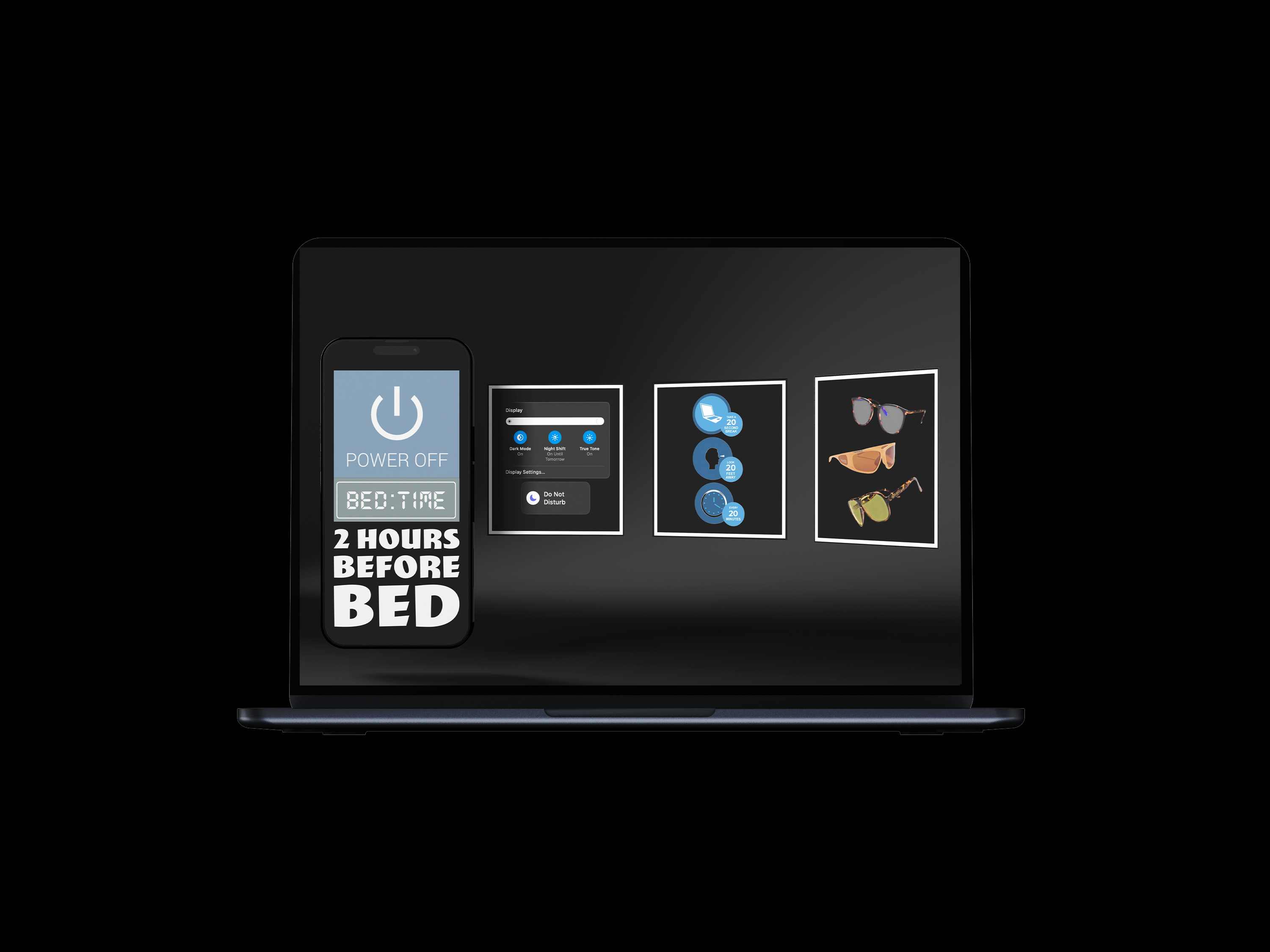
One helpful tip is the 20-20-20 rule. If you have been staring at a project too long in Photoshop, look at an object at least 20 feet away for 20 seconds every 20 minutes. This will help reset your vision, allowing your eyes to return to a more comfortable state. To avoid computer vision syndrome, try wearing blue light glasses that filter out the toxic rays. Traditional blue light glasses tend to have an orange/yellow tint to them which helps cancel out the blue light. But, graphic designers must be careful when choosing what glasses to buy. Due to the tinted lens, your perception of color will become distorted. Using these glasses during color critical work will cause designers to overcompensate by adding too much blue or magenta to their designs. Digital design professionals should substitute that style of glasses for a pair with clear lenses that offer a high Color Rendering Index (CRI) of 95+ and light transmission over 90%. Coinciding with the glasses, make sure your monitor is accurately calibrated while wearing them to ensure a consistent color workflow.
“An eye for an eye only ends up making the whole world blind.” – Mahatma Gandhi
Cognitive Disruption
It doesn’t stop at the eyes. Blue light dramatically affects sleep quality, which then can lead to more serious issues. We all love nothing more than to get into bed after a long day and doom scroll, but it has to stop. Nighttime screen use disrupts circadian rhythms 3 by suppressing the sleep hormone melatonin. Hormone suppression occurs when blue light mimics the brightness of the sun, which then tricks the brain into pausing melatonin production. Studies done by Harvard Health have also shown that blue light suppresses melatonin for almost twice as long as green light which holds the same brightness and causes deeper shifts to the body’s internal clock. All of this will lead to brain fog and slowness during the following day, ultimately leading to a performance decline at work and a lack of creative thoughts.
Luckily, there are simple fixes to help reset your body’s sleep schedule.
“The nicest thing for me is sleep, then at least I can dream.” – Marilyn Monroe
Tips for a cognitive reset
First, you should avoid using any digital devices at least two hours before going to sleep. This will help your body wind down and replenish your natural melatonin levels. Next, it is recommended to take advantage of your device’s built-in features that help you get ready for bed. Go into your devices settings and look for a “Night Shift” or “Dark Mode” button which adds a warmer tint to your screen, almost like blue light glasses for your computer. The night settings featured on your device should also include a feature where you can set a time on your phone where it automatically switches to screen to the warmer tones. I would recommend setting this feature to turn on four hours before you go to bed so that you still have time to work and relax before practicing the two hour rule. To help put your body at ease, the vitamin Magnesium Glycinate4 helps to combat the stimulating effects of blue light and relaxes the body’s muscles.
“Sleep is the golden chain that ties health and our bodies together.” – Thomas Dekker
At the end of the day, graphic designer or not, you need to put the device down. Not only will it help your mental and physical health, but it will also force you to immerse yourself in nature and the environment that surrounds you. The artistic flow and connection comes from unplugging. Creativity stems from the mind, not the screen. Take a step back from your screen, give your eyes a break, and allow your body’s natural cycle to return to normal. Allocate time in your day for small “blue light detox breaks” and remember to breathe.
“Creativity is just connecting things. When you ask creative people how they did something, they feel a little guilty because they didn’t really do it, they just saw something.” – Steve Jobs
Extra resources to further your knowledge about blue light
Hoya | Blue Light: Should You Be Concerned?
Average Screen Time for Adults: Workplace & Leisure Data 2025
Harvard Health | Blue light has a dark side
Lensmart | Eyewear for Graphic Designers: Maintaining Color Accuracy
Glossary
- Macular Degeneration 1 – An eye disease that blurs central vision by damaging the macula, then central part of the retina. It affects sharp, straight-ahead vision needed for reading and driving. While it does not cause total blindness, it is a leading cause of vision loss in adults over 50.
- Chromatic Aberration 2 – Affects visual quality and comfort when viewing print on computer screens and other digital displays, and is believed to be a factor in eye strain that’s common among users of these devices. Typically accompanied with a violet-blue “blur circle” around the cornea.
- Circadian Rhythm 3 – Your body’s natural internal clock, operating on a roughly 24-hour cycle. It governs essential biological processes, most notably your sleep wake cycle, but also hormone release, digestion, and body temperature. A human’s circadian rhythm is directed by the suprachiasmatic nucleus (SCN) (“The Master Clock”), a cluster of nerve cells in the brain’s hypothalamus.
- Magnesium Glycinate 4 – A highly absorbable, bioavailable magnesium supplement bound to the amino acid glycine. It is widely used to correct deficiencies, ease digestive issues, relieve muscle cramps, support bone density, and promote relaxation.
- UV Rays 5 – Ultraviolet (UV) radiation is a form of electromagnetic light energy invisible to the human eye, measured in nanometers (nm). It is divided into three primary types based on wavelength:
- Ultraviolet A (UVA): The longest UV wavelength (315 nm – 400 nm). It accounts for about 95% of the solar UV radiation that reaches the Earth’s surface. It penetrates deep into the skin and causes premature aging, wrinkles, and long-term cell damage, contributing to skin cancer. It is also responsible for immediate tanning and can penetrate glass.
- Ultraviolet B (UVB): Medium UV wavelength (280 nm – 315 nm). Most of it is absorbed by the Earth’s ozone layer, but a small amount reaches the surface. It primarily damages the outer layers of the skin, causing sunburns and direct DNA damage. It is the primary catalyst for the development of most skin cancers and is also required for the skin to produce vitamin D.
- Ultraviolet C (UVC): The shortest wavelength and most dangerous type of UV radiation. It is completely absorbed by Earth’s atmosphere and ozone layer, meaning natural UVC does not reach the Earth’s surface. Artificial UVC is actively used in occupational and media settings as a germicidal agent to kill bacteria and viruses.
 COMM380 | DIGITAL MEDIA WRITING
Leave a comment